
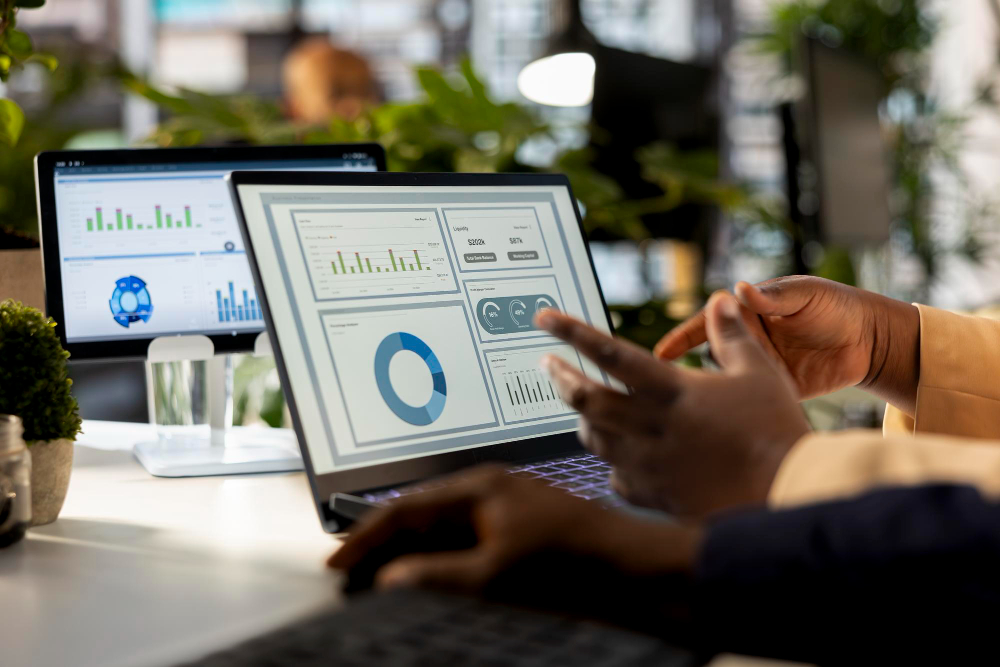
In today’s data-driven business environment, the volume of organizational data is growing exponentially. Managers can no longer rely on traditional reports or scattered spreadsheets to make timely and accurate decisions. This growing need for fast data analysis and effective monitoring of key performance indicators (KPIs) has led to the widespread adoption of management dashboards as critical decision-support tools.
This article provides a clear and practical explanation of what a management dashboard is, its core applications, and why it has become a necessity for modern organizations. It also highlights its key features, benefits, and role in improving managerial effectiveness and organizational productivity.
What Is a Management Dashboard?
A management dashboard is a visual analytical tool that presents critical organizational data using charts, graphs, and key metrics in a single, unified view. It enables managers and in some cases operational users to monitor performance, track project progress, and evaluate overall organizational health at a glance.
From a broader perspective, a management dashboard functions as a decision-support system, helping managers continuously monitor team and process performance while identifying trends, deviations, and improvement opportunities.
By providing real-time and visually structured insights, dashboards transform raw data into actionable intelligence and enhance data-driven decision-making.
The Importance of Using Management Dashboards
Management dashboards consolidate dispersed organizational data and present it in a single, coherent environment. This allows decision-makers to gain immediate visibility into business performance and operational status.
By simplifying complex data and presenting KPIs in a clear visual format, dashboards accelerate decision-making and reduce reliance on manual analysis. The combination of real-time data and historical trends enables continuous monitoring and timely corrective actions.
As a result, management dashboards have become a cornerstone of modern management, playing a vital role in control, analysis, and strategic planning.
Defining KPIs in Management Dashboards
Management dashboards are tightly integrated with Key Performance Indicators (KPIs)—quantifiable metrics used to measure the performance of individuals, teams, processes, and the organization as a whole.
In practice, KPIs are displayed through numeric indicators, visual charts, and status signals, allowing managers to assess performance quickly. Each KPI is directly linked to a specific organizational objective, and its data is typically collected automatically from operational systems.
KPI Selection Based on Organizational Goals
KPIs must be defined in alignment with strategic objectives such as increasing profitability, improving efficiency, or enhancing customer satisfaction. Depending on business needs, KPIs may focus on inputs (resources, quality, cost) or outputs (production volume, service delivery, task completion).
Selecting the right KPIs ensures that dashboards reflect meaningful performance insights rather than overwhelming users with irrelevant data.
Key Features of an Effective Management Dashboard
An effective management dashboard should include the following characteristics:
Simplicity and clarity in design for fast comprehension
Focused monitoring of relevant KPIs aligned with organizational goals
Real-time data updates to support timely decisions
Data integration from systems such as ERP, CRM, finance, and HR platforms
Filtering and personalization based on user roles and access levels
High security and reliable access to critical managerial information
Types of Management Dashboards and Their Use Cases
1. Operational Dashboards
Monitor daily operations, productivity, and process efficiency.
2. Financial Dashboards
Provide real-time visibility into revenue, costs, cash flow, and financial ratios.
3. Executive Dashboards
Offer high-level insights into overall organizational performance for senior leadership.
4. Marketing Dashboards
Track campaign performance, lead generation, conversion rates, and brand awareness.
5. Human Resources Dashboards
Monitor workforce metrics such as turnover, recruitment efficiency, and employee engagement.
6. Sales Dashboards
Analyze sales performance, pipelines, quotas, and revenue opportunities.
7. Customer Service Dashboards
Measure customer satisfaction, support response times, and retention metrics.
Key Benefits of Management Dashboards
- Unified visibility across organizational priorities and departments
- Centralized access to fragmented data
- Seamless integration with enterprise systems
- Real-time access to critical KPIs
- Continuous monitoring of projects and initiatives
- Improved follow-up on managerial decisions
- More accurate, data-driven decision-making
- Increased transparency and cross-department alignment
Risks of Poor Dashboard Design
If dashboards are not designed correctly, they can become ineffective or even misleading. Common risks include:
Overly complex or visually cluttered designs that reduce usability
Excessive or irrelevant data that obscures key insights
Incomplete or inaccurate data leading to flawed analysis
Weak alignment between KPIs and actual business objectives
From a Business Process Management perspective, management dashboards are not just reporting tools, they are process control and optimization instruments.
When integrated with BPMS platforms, dashboards provide real-time visibility into process performance, bottlenecks, SLA compliance, and continuous improvement opportunities, enabling organizations to move from reactive management to proactive, process-driven governance.
Price
This article is for free use
Send Comment

We started our activity in the field of website design and mobile programming in 2013. Our team has been working professionally for more than 8 years on the personalization of the ProcessMaker BPMS.
We are at your service in the fields of process design and implementation, application and practical and security plugins, expert advice and training, updating the old version of Process Maker, and so on.